THE RESPONSIBLE BODY: A
EUCHARISTIC COMMUNITY
by Matthew Whelan
MATTHEW WHELAN completed
his undergraduate degree at the University of Virginia in May 2000.
This essay from his senior's thesis, "I Was Hungry and You Gave
Me Food: A Spirituality of Nourishment." He currently lives in
Joyas del Carballo, Honduras, working as a Peace Corps
volunteer.
ELIZABETH WHELAN, whose
photography illustrates this article, is a student at the University
of Virginia. After spending last summer in Lusaka, Zambia, working on
a photo essay documenting daily life at Kasisi Orphanage, she received
a Harrison Undergraduate Research Grant to spend six weeks in
Honduras. There, she photographically documented the role of the
Catholic Church in the recovery process after Hurricane Mitch.
The hungry body is a
critique of the state and of the church.
A
woman of forty, but who looked as old as seventy, went up to the
priest after Mass and said sorrowfully: "Father, I went to
communion without going to confession first. . . I arrived
rather late, after you had begun the offertory. For three days I have
had only water and nothing to eat; I'm dying of hunger. When I saw you
handing out the hosts, those pieces of white bread, I went to
communion just out of hunger for that little bit of bread."(1)
"There are so many hungry people
among us," prayed Padre Andres. . . as he held the
consecrated loaves in his hands, "that God would only dare to
appear in the form of bread."(2)
The encounter with God does not come to
[us] in order that [we] may henceforth attend to God but in order that
[we] may prove its meaning in action in the world. All revelation is a
calling and a mission. But again and again [we shun] actualization and
[bend] back toward the revealer: [we] would rather attend to God than
the world. . . [and] thus. . . will not let the
gift take full effect but [instead reflect] on that which gives, and
[miss] both.(3)
The Eucharist is the principal act of worship of the majority of
the billion and a half or so Christians in the world today. It has
been, since the church's beginnings, an integral part of its identity.(4)
Among the many possible reasons for this emphasis, there is one so
palpable, so unquestionable, it stands out among the others: it is a
meal. As a meal, it resonates with the most basic practices necessary
for life and its nourishment. In the Eucharist, extraordinary
attention is drawn to the utterly ordinary.
The Eucharist is the communal remembrance of Jesus' gift of himself
for others. When Jesus instituted the Eucharist, he spoke of the bread
as his body. But he was concerned with bread not only at the last
supper. Issues surrounding food, feeding, sharing meals, and the
banquet at the end of the age, marked his entire ministry. Concern
with food animated a life, followers believe, lived as a gift for
others. So when he takes the bread, breaks it, shares it, tells his
disciples that the bread is his body and that they should "do
this in remembrance" of him, he speaks of a way of living in
which his followers' bodies, like his, are to be gifts for the
nourishment of others. Such bodies are Eucharistic: the spirit that
moves them is one of concern for the nourishment of others. It is
through this labor of peace, in which the self pours itself out
(Isaiah 58:10), that individual bodies and the communal bodies in
which they participate bear witness to the lord's light, which
flickers in our world like a candle in danger of being extinguished.
The meanings of the Eucharist, then, lie both in the bread itself
and what is done with it. In the texture of the bread, the materiality
of the meal, and the necessary recognition by the church body of the
meal, the Eucharist connects with human hunger. The divine breaks into
history in the ways in which the members of the church body understand
their own food and the food of others, and how they understand their
identity in relation to the hunger of others.
The Eucharist is no mere moment in a mass or service. Rather, it is
the summit of Christian life, toward which everything is directed and
from which everything flows.(5)
But it is not the usual kind of summit; it is not abstract or ethereal
or difficult to comprehend. The Eucharistic community is a paradigm of
a communal response to human hunger, one which offers an alternative
vision of what constitutes a peaceful social body -- one that is,
perhaps, comparably easy to envision since its embodiment can be
touched, tasted, and swallowed.
In Torture and Eucharist, William Cavanaugh speaks of a
"Eucharistic ecclesiology," or a church community structured
upon the performance of the Eucharist, and how that practice embodies
a "counter-politics"(6)
to the politics of the world. When Cavanaugh speaks of the Eucharist,
he uses words like "performance," "practice," and
"politics" to denote the active dimension of participation
in the Eucharist.
The Eucharist is the redemptive self-gift of Jesus in the form of
his body, which is given up out of love for others. Participation in
the liturgical remembrance of Jesus' gift of his body transforms the
bodies of participants into gifts for others. Augustine captures this
in his Confessions: "I am the food of the fully grown;
grow and you will feed on me. And you will not change me into you like
the food your flesh eats, but you will be changed into me."(7)
This transformation does not lead to the abandonment of or withdrawal
from the world, but engagement with it, which seeks its mending. In
its life as church, as well as in the words arising from that life,
the church prophetically critiques a world that pays no heed to
hunger.
In a Eucharistic ecclesiology, the church is not merely a
collection of individuals, but a communal enactment of an alternative
way of being-in-the-world. This the root sense of the word
"liturgy."(8) To
enact communally the Deuteronomist's injunction that "there shall
be no poor among you" (15:4), or the promise of the Magnificat
that the hungry will be well fed (Luke 1:53), is in Cavanaugh's words,
"already to be engaged in a direct confrontation with the
politics of the world."(9)
To work to alleviate the hunger of others is to engage in a
counter-politics.
To speak of the Eucharist as embodying a counter-politics might
seem odd to Americans accustomed to the separation of church and
state, religion and politics. These distinctions, however, were created,
not discovered. In State Theory: Putting Capitalist States in
their Place, Bob Jessop notes: "It was only in the
seventeenth century that politics was first linked to the idea of an
abstract, impersonal, sovereign state distinct from other parts of
society (church, economy, civil associations)."(10)
As John Milbank contends in Theology and Social Theory, the
notion of the "secular," as well as a certain conception of
the "political," had to be "imagined, both in
theory and practice." It was the late medieval nominalists, the
protestant reformers, and seventeenth-century Augustinians who
"completely privatized, spiritualized, and transcendentalized the
sacred, and concurrently reimagined nature, human action, and society
as a sphere of autonomous, sheerly formal power." The story told
by secularists is one of a gradual desacralizing or the removal of the
superfluous, leaving a pure residue of the human. But this story is
fundamentally flawed, for it overlooks the "positive
institution" of the secular, in which the political came to be
defined "as a field of pure power."(11)
The creation of the political as a field of pure power is
significant, not because it encourages us to long nostalgically for
Christendom, but because it highlights what exactly is at stake in the
politics of the current organization of the social body. In Weber's
famous definition of the modern nation-state, for example, the state
is "a human community that (successfully) claims the monopoly of
the legitimate use of physical force within a given territory."(12)
The state is not defined in terms of its ends, for it has no ends
other than its own self-preservation, but by its means, which is
coercive violence. For the state, the self-preserving conatus,
provides the "universal hermeneutic key."(13)
The state's monopoly on legitimate violence produces "peace"
by taming the conflict of power among social groups, which differ from
the state only in their lack of access to the means of legitimate
violence.
In Realist Thought from Weber to Kissinger, Michael Smith
argues that for Weber, like all realists, a struggle for power
pervades human existence:
The struggle for power
-- which defines politics -- is a permanent feature of social life and
is especially prominent in the relations between states. . .
States act according to their power interests, and these interests are
bound at times to conflict violently. Therefore, even if progress
toward community and justice is possible within states, the relations
between them are doomed to permanent competition that often leads
to war.(14)
Milbank sees the theme of "original violence" articulated
here, which "assumes some naturally given element of chaotic
conflict which must be tamed by the stability and self-identity of
reason," as a "thread of continuity" between
"antique reason and modern, secular reason." Christianity,
on the other hand, "recognizes no original violence," but
"construes the infinite. . . as harmonic
peace. . . [which is] the sociality of harmonious
difference."(15)
If the sociality of which Milbank speaks is to be peaceful, it must
include responsiveness to the hunger of others. Such responsiveness is
constitutive of a peaceful social body, which attends to the
sufferings of others. When everyday life for the hungry is pervaded by
violence, such responsiveness is the only possibility of the sociality
of harmonious difference. Otherwise, the difference between
those who hunger and those who don't remains characterized by
violence.
Thinking in this way exposes how the assumption of the necessity of
hunger contributes to its persistence in the world. Ultimately at
stake are alternative definitions of the polis, the social,
the wholeness of being human. The issue is how social bodies are
imagined.(16) The political
is a much broader concept than simply the competition among
nation-states. If we broaden polis to mean a community
embodying the organization and fulfillment of human social relations,
then the state, an organization which arose at a specific time and
place, is not the only way but simply one way of
imagining the organization of a social body.(17)
This is not to say that Christians should engage in a revolutionary
overthrow of the state. Rather, it is crucial that we see how the
violence embodied by the nation-state system might not be ideal,
logically proper, or the model of what it means to organize and
negotiate our living together. Insofar as it is constituted by
violence, the existing political and economic orders should not be
simply taken for granted. When hunger is understood as an acceptable
reality in the politics of competing states, the conviction that
hunger is intolerable is itself revolutionary. The attempt to unimagine
its necessity in our present actions transcends and relativizes
national commitments. This opens the space for alternative accounts of
how we live with and relate to one another, the possibility of a
peaceful society within a violent one.(18)
The toleration of hunger is simply one way of envisioning the
organization of the social body; the rejection of hunger requires the
imagination of a radically new organization.
Contrary to popular belief, the church is not apolitical, for in
its very existence it is a political body. It is not political in the
Weberian sense; it does not strive to attain a monopoly upon
legitimate violence. What is at issue is not a distinction between the
spheres of religion and politics, but rather, between alternate
conceptions of the political itself. Milbank, among others, has
argued that Augustine's project in the City of God is a
reimagination of the political.(19)
For Milbank, City of God is first and foremost about the
community of the church as an alternative city or altera civitas,
with its own social theory grounded in a "Christian mode of
action, a definite practice."(20)
This underscores the praxis of the church as a distinct society,
constituted by peace. Milbank makes no attempt to represent an
"objective" social reality. Instead, the social knowledge
advocated is the imagination-in-action of a peaceful social order.(21)
In its responsiveness to the hunger of others, in its concrete
being-with people in their hunger, it is a
"critique-through-practice"(22)
of the present organization of the social body.
In its praxis of peace, the church in the world, or altera
civitas, embraces a different metanarrative than the earthly
city, or civitas terrena, which is governed by violence. It
is not that the altera civitas embraces a mythos
that the civitas terrena does not. Rather, the secular social
theory of the civitas terrena embodies a mythos
which, Milbank contends, is nothing less than another theology, one
which imagines the priority of power and conflict over peace.
Limiting this discussion of the reimagination of the political to
Christianity alone, however, is flawed. A powerful example of this
alternative imagining of the political can be found in Israelite
prophecy. This is the main argument in Walter Brueggemann's book, The
Prophetic Imagination, in which he writes: "The task of
prophetic ministry is to nurture, nourish, and evoke a consciousness
and perception alternative to the consciousness and perception of the
dominant culture around us."(23)
The prophetic heritage enriches a Eucharistic counter-politics. At the
center of the prophetic social vision is a concern for justice (mishpat)
and righteousness (tsedeq-tsedaqa), two concepts which are
starkly incompatible with an indifference to the persistence of
hunger. These terms, together, connote an active concern for the
"least" within the social order. For the prophets, this
concern is the essential prerequisite of a social body characterized
by peace (shalom). The inauguration of a peaceful human
community begins with an approach toward God manifested in justice and
righteousness done to the poor.
The prophets help us to understand that discussions of peace cannot
be separated from this concern for the poor. The prophets speak in
order to urge turning (swb)(24)
of the people to right relation with God, a relation which is
inseparable from justice and righteousness. For the prophets, one
cannot think of God and be indifferent to the hunger of others.(25)
As Hermann Cohen writes, "[the prophets] wish to address man's
heart. . . and arouse his compassion. . .
compassion becomes the motivating force of an entire Weltanschauung
[worldview]."(26)
For a church focused upon the communal performance of the
Eucharist, and situated squarely in the prophetic tradition, hunger is
symptomatic of a profound wrong in the present social organization. We
might contrast an image, found in Shakespeare's Coriolanus, of a
disordered social body, in which hunger persists and is tolerable,
with Paul's vision of the church body in 1 Corinthians 12. In his
"pretty tale," Mineneus depicts the disorder of a social
body: a headless entity with a grotesque, smiling belly. His speech is
part of an effort to quell a rebellion that has broken out over the
lack of food, in opposition to the rich of the city who have
purportedly hoarded the food for themselves. (27)
Paul's description of the church as a social body contrasts vividly
with Minenius'. For Paul, when one member of the church suffers, all
suffer (1 Corinthians 12). For the church, the existence of
hunger is never social order but is always disorder.
Today, there are many hungry Christians, a fact that too rarely causes
suffering, let alone thought, for those Christians who are well fed.
When a woman eats the Eucharistic host simply out of hunger, yet
Christians in America eat excessively, there is a problem in the very
fabric of the church, running through its identity like a weak seam,
calling into question its present organization and self-understanding.
When the practice of the Eucharist is central in the life of the
church, the breaking and sharing of bread is a critique of the present
organization of the hungry social body. The church is nothing less
than the body of Christ; in their existence for others, the bodies of
the church members are Christ's body in the world. "The church is
the church," Dietrich Bonhoeffer writes, "only when it
exists for others."(28)
Like the Eucharist itself, the bodies of church members are food for
the nourishment of the world, to be broken, shared, and consumed. As
Monica Hellwig writes in The Eucharist and the Hunger of the
World, "to accept the bread of the Eucharist is to accept to
be bread and sustenance for the poor of the world."(29)
For Gustavo Gutiérrez, this means the church "has to rethink
itself from below, from the position of the poor of this world, the
exploited classes, the despised races, the marginal cultures. It must
descend into the world's hells and commune with poverty, injustice,
and the struggles and hopes of the dispossessed."(30)
Gutiérrez's ecclesiology, like Bonhoeffer's, exemplifies what James
Nickoloff calls an "ecclesial shift" from "moral
exhortation to solidarity."(31)
To measure the church by its solidarity with human suffering is what
it means to speak of the church as a communal enactment of a
counter-politics, in which the bodies of church members pour
themselves out on behalf of the hungry.
The church is called to be companionate because Jesus breaks bread,
shares it, tells his followers that the bread is his body, and that
they should "Do this in remembrance" of him (1 Cor.
11:24). The Eucharistic practice of breaking bread and sharing it is
not restricted to the inauguration of the Eucharist at the Last
Supper, but, as was mentioned before, is reflected in Jesus' concern
with food and feeding throughout his public ministry.(32)
An ethics of companionship underlies the New Testament as a whole. In The
Moral Vision of the New Testament, Richard B. Hays writes:
The New Testament
witnesses speak loudly in chorus: the accumulation of wealth is
antithetical to serving God's kingdom, and Jesus' disciples are called
at least to share their goods generously with those in need, and
perhaps even to give everything away in order to follow him more
freely. . . For the church to heed the New Testament's
challenge on the question of possessions would require nothing less
than a new Reformation. (33)
The paradigm for compassion is that Jesus' body is given up for
others. The church is therefore called to "make up what is
lacking in Christ's afflictions" (Col. 1:24) in its participation
in God's suffering in the world. Cavanaugh views the significance of
this in the following way: the "Eucharist is the liturgical
realization of Christ's suffering and redemptive body in the bodies of
His followers. . . the Eucharist effects the body of Christ,
a body marked by resistance to worldly power."(34)
The suffering bodies of Jesus' followers become redemptive when their
suffering is undergone on behalf of others, as Christ's was.
Exposure to danger was a central aspect of Jesus' own
initiation/inauguration of the Eucharist; this is no less the case
today. To stand with the hungry in resistance to the processes of the
world creates witnesses to the Lord, but also martyrs. This is what
Larry Rasmussen has called the "costly worldly solidarity"(35)
of the church. As Gutiérrez writes, "few things are as
life-threatening as defending the right to life. The path of
commitment to the poorest. . . is strewn with imprisonment,
torture, disappearance, exile, and death."(36)
This is a conception of salvation, to paraphrase Archbishop Romero,
which would not offer heaven without a renewed earth. Living as we do,
in a world in which the cross has not been superseded, in which God
hungers in the hunger of others (Matthew 25:31-36), there can be no
quick leap across Gethsemane and Calvary.
---
In the Eucharistic meal, eating is a radically public, communal
act. Juxtaposing the Eucharistic meal with the strain placed upon the
communal relations of populations facing acute starvation(37)
spotlights what is at stake in a Eucharistic counter-politics in a
world of hunger. In Torture and Eucharist, Cavanaugh analyzes
the way the state practice of torture engenders a social imagination
in which individual bodies are organized into a collective
performance, not of community, but of atomized, mutually suspicious
individuals. Such is the case with hunger, too. In Death without
Weeping, Nancy Scheper-Hughes notes that the hungry of the
Brazilian Northeast do not like to eat in front of others, for "[t]here
is a great deal of shame associated with eating. Eating is almost as
private an act as sex or defecation. . . Eating in
public. . . shows the extent of one's desires,
the. . . bottomless pit of one's needs."(38)
For Cavanaugh, resistance to hunger, like resistance to torture,
"depends upon the reappearance of social bodies capable of
countering the atomiz[ation]."(39)
It depends upon the reappearance of social bodies in which eating
becomes radically public. This is the task of the church.
Hunger's
atomizing effect upon communal bodies is not unique to the Brazilian
Northeast. Jean Dreze and Amartya Sen note that when communities
hunger, "the ordinary rules of patronage, credit, charity,
reciprocity, and even family support tend to undergo severe strain and
can hardly be relied upon to ensure the survival of vulnerable
groups."(40) When people
are hungry, the horizon of their vision tends to progressively shrink
-- from the community as a whole, to immediate family, then finally,
to the individual. Often, a point is reached in which everything is
subsumed in an individual's struggle for physical survival. This is
summed up in a Rwandan proverb: "Hunger makes you selfish to the
point of letting your own child perish."(41)
That such a proverb even exists in the collective conscience of a
people speaks volumes.
There have been numerous accounts of this phenomenon. Colin
Turnbull has given an account of the collective experience of hunger
of the Ik in Uganda.(42)
Social bonds, cooperation, and sharing disappeared as the Ik became,
not a community, but a collection of starving individuals. In their
research on Warsaw and in the Austrian village of Marienthal, B. Zawadzki
and Paul Lazarsfeld described a people for whom "the
consciousness of belonging together did not bind any longer" and
among whom there "remained only scattered, loose, perplexed, and
hopeless individuals."(43)
James Davies concluded about this study: "without enough to eat
there is not a society."(44)
In his research on the German concentration camps, Bruno Bettelheim
stressed desocialization due to hunger. A British physician,
F. M. Lipscomb, who was a member of the British Army unit that
liberated Bergen-Belsen noted an "increasing selfishness, more or
less proportional to the degree of undernutrition."(45)
In the Scheper-Hughes analysis of the Brazilian Northeast, this
atomization of the social body happens not simply in the way that
people eat, but in how they understand their hunger as well. She
speaks of "the medicalization of need."(46)
The "madness of hunger," once understood as the end point in
the experience of a starving community, becomes transformed
into an individual problem, one which is psychological and
requires medications. Hunger is individuated and denied by the medical
authorities and those with social power. An individuated discourse on
sickness and "nervousness" (nervosos) replaces a
more socialized discourse on hunger.(47)
The hungry understand themselves primarily as sick and only
secondarily as hungry.
The medical appropriation of hunger, the failure of those in power
to see hunger as hunger, as well as their willingness to treat it with
tranquilizers, vitamins, sleeping pills, and elixirs, is not simply a
misuse of medical knowledge; as Scheper-Hughes argues, it is also
"an oblique but powerful defense strategy of the state." The
social presence of hunger is a standing critique of the social body as
it presently exists in the form of the Brazilian state. For Scheper-Hughes,
these state processes represent "a macabre performance of
distorted institutional and political relations. Gradually the
hungry. . . have come to believe that they desperately need
what is readily given to them [medications], and they have forgotten
that what they need most [food] is cleverly denied." A hungry
body implicates the state. A sick body, on the other hand, implicates
no one: "[s]uch is the special privilege of sickness as a neutral
social role. . . In sickness there is (ideally) no blame, no
guilt, no responsibility."(48)
Hunger affects not only how people eat and how they understand
their need, but on a much larger scale imbues every aspect of their
lives with what Scheper-Hughes calls "a free-floating,
ontological, existential, insecurity." The individual bodies of
the region's inhabitants, like the social body itself, are understood
as "shaky, nervous, and irritable." The people's anxieties
about hunger dominate their perceptions of their own bodies. They
describe themselves as breathless, wobbly, disoriented, embarrassed,
unsure of their gait, constitutionally weak, and frail. These
anxieties also dominate their perception of the social body of the
state. Scheper-Hughes notes how the nervous and weak body of the
hungry person serves as a metaphor for the political and economic
system and the weak position of the poor within that system.(49)
The Eucharist is a radically contrasting vision to the atomization
that social bodies experiencing acute malnutrition undergo. This
atomization is precisely what the church as a communal body seeks to
counter through its existence in companionship and compassion.
---
Early Christians considered eating together and sharing food with
one another the proper way both to recall Christ's life, death, and
resurrection, and to affirm their hope of his return. Hunger distorts
such a remembrance. This is precisely why Paul criticizes the
performance of the Eucharistic meal at the church in Corinth (1 Cor.
11). Poorer Christians and slaves, who could come only later to the
gathering, participated in the rite of the bread and the cup, but were
excluded from the main meal itself. Paul regarded this as a scandal,
which made it impossible for a true Lord's Supper to take place
(11:20). Paul views such an exclusion as a violation of the essence of
the institution of the Lord's Supper itself (11:27). The Eucharist
fails if it does not resist the discrimination between rich and poor
that exists in the larger society. For a community today to partake of
the bread and the cup, but give no communal response to hunger, is to
fail to enter into the deepest dimension of the Eucharist.
Cavanaugh, Henri de Lubac, and Michael de Certeau,(50)
among others, have documented how an inversion came about in
Eucharistic theology. Patristic and early-medieval tradition, using
the Pauline images of the body of Christ, spoke of the sacramental
body of the Eucharist as corpus mysticum, or the mystical
body of Christ, and the church as corpus verum, or the true
body of Christ.(51) Around
the twelfth century, however, there was an inversion of meaning. In
following centuries, the sacramental body of the Eucharist was
increasingly seen as Christ's corpus verum, and the church,
his corpus mysticum.(52)
As corpus verum, the Eucharistic host became an object of
reverence, rather than the center of a communal performance. The
emphasis was increasingly placed upon the miracle of
transubstantiation in the priest's blessing of the bread and wine,
rather than the transformation of the community itself in its
participation in the Eucharist.(53)
Cavanaugh notes the way the silent contemplation of the Eucharistic
miracle corresponded with a diminishing of the communal nature of the
Eucharist and an individualizing of Eucharistic piety.(54)
Dom Gregory Dix describes this trajectory in church practice of the
Eucharist as follows: "The old corporate worship of the [E]ucharist
is declining into a mere focus for the subjective devotion of each
separate worshiper in the isolation of his own mind. And it is the
latter which is beginning to seem to him more important than the
corporate act."(55) The
increased localization of the sacred in the host had the effect of
secularizing all that lay beyond it.(56)
In For the Nations, John Howard Yoder attempts to recover
the economic dimension of the Eucharistic celebration, evident in
Paul's criticism of the church at Corinth. In the history of
Eucharistic theology, emphasis increasingly has been placed upon the
worship of Christ in the host. Adoration replaced sharing.
Controversies have raged over what happens to the bread and wine when
the priest blesses it. But as Yoder contends, these controversies have
obscured from our memory
the fact that the
primary meaning of the [E]ucharistic gathering in the Gospels and Acts
is economic. It was the fulfillment of the promise of the Magnificat
that the rich would give up their advantages and the poor would be
well fed. . . At the Lord's table, those who have bread
bring it, and all are fed; that is the model for the Christian social
vision in all times and places.(57)
In another essay in the same collection, Yoder writes that the
Eucharist is "the paradigm for every. . . mode of
inviting the outsider and the underdog to the table."(58)
The Eucharist extends the boundaries of economic solidarity, normally
restricted to the family, to include the widow, stranger, orphan,
alien, and hungry.
In comments like Yoder's, we begin to get a sense that the
Eucharist has much to say in terms of the way Christians orient both
their bodies and their resources toward the world. In God without
Being, Jean Luc Marion asserts that this orientation toward the
world, modeled upon the Eucharist, must be understood in terms of the
gift. Marion argues that the Eucharist as gift is governed by the
charity of God's free gift of love, which sustains each moment of the
present. In order to receive the Eucharist properly, one does not
explain the gift, but is assimilated into its movement in the
performance of companionship and compassion. Thus, our failure to
recognize the gift, which is love, lies precisely in our failure to
love. What Marion calls the "Eucharistic present" is
"the commitment of charity," which signifies the true
reception of the gift of the Eucharist.(59)
This entails proving its meaning in our lives in the world.
The Eucharist is therefore not a gift we receive while remaining
unaltered. Rather, if we think of the Eucharistic gift as a constantly
flowing river, we might say that one who treats the gift correctly
does so by allowing oneself to become a channel for its current. The
incorrect way to receive the gift is to dam up the river.(60)
Passing the gift along through one's body as well as through one's
participation in communal bodies, both of which open outward toward
others, is the labor of gratitude that is the true acceptance of the
gift. The Eucharist becomes communion bread in the church's concern
for the bread of the hungry. This is the connection made by Padre
Andres in one of the above epigraphs: "There are so many hungry
people among us that God would only dare to appear in the form of
bread.' "
This notion of the gift, which underlies the Eucharist, is at the
heart of Gutiérrez's theology. James Nickoloff writes that "[t]he
central axis of Gutiérrez's entire theology is the
gratuitous. . . love of God."(61)
This is evident in Gutiérrez's insistence in A Theology of
Liberation that "a spirituality of liberation must be filled
with a living sense of gratuitousness. Communion with the Lord and
with all humans is more than anything a gift."(62)
Gutiérrez speaks often about the gratuitous nature of God's love and
the responsibilities to which it calls us.
For Gutiérrez, to think of the world and everything in it in terms
of a gift does not render one passive. Rather, as we have seen above,
if received properly, the gift awakens a sense of gratitude in one
that accepts it, a gratitude that is made flesh in the receivers'
body. If God is love (1 John 4:8), and love is fluid and dynamic
like a river, then God is not approached by standing and watching on
the bank, but by swimming with the current. Love cannot be contained
within the self, but must flow through the body in works of love. To
see the world and everything in it as a gift, yet possess great
abundance while others have nothing, are starkly incompatible notions.
The self's abundance is a responsibility to be of service to those who
live in poverty.
In one of his Talmudic commentaries, "The Youth of
Israel," Levinas speaks of responsibility on the model of the
gift. A passage in this commentary concerns saying grace before a meal
and the Third World. We pray before a meal in order to see the food we
eat as a gift. But what does it mean, Levinas asks, to see food as a
gift? It means seeing our possessions not as rewards bestowed upon us
or as our inalienable property, but as things for which "thanks
must be given and to which others have a right."(63)
To bless food is to realize that one is not in ultimate control of
one's nourishment. Consider all that must happen, for example, for a
loaf of bread to appear on the shelves at a supermarket. Grain must be
extracted from the earth, ground, shipped, stored, mixed, baked,
packaged, and delivered. At each point in this process, countless
others perform numerous tasks. To see bread as a gift allows us to see
the need of others for whom food is also a gift, but a gift that might
have, in some way or another, been diverted.
For Levinas, the essence of the gratitude expressed in a mealtime
prayer lies in the responsibility it lays upon the self to acknowledge
and work to provide for others' need of food. The giving begins with
the individual body, but moves to the level of the communal body,
which "must follow the individuals who take the initiative of
renouncing their rights so that the hungry can eat. . . [T]here
must be. . . in the world. . . a source of
disinterestedness so [the hungry] can eat."(64)
In "God's Loving Care and Human Suffering," Bonhoeffer
points to the uneasiness that we who live in a land of abundance
should feel at the fact that we have so much while others have so
little. This uneasiness unsettles the core of ourselves. It is the
beginning of the recognition of the responsibilities incumbent upon us
as a result of the gifts we have received. The very act of eating
food, recognized as a gift, places obligations upon Christians in the
First World to whom much has been given.
We likewise see this trajectory in the prayer Jesus taught his
followers to pray, the "Lord's Prayer." In this prayer, the
supplicant prays: "Give us this day our daily bread." These
words are not at the beginning of the prayer nor at the end of it;
they are at its very center, beating there like a heart. "Give us
this day our daily bread." The concern here is not me and my
salvation. The concern is not even me and my bread. It is our
bread for which we are taught by Jesus to pray. In this most central
prayer of Christianity, those who pray find themselves enfolded into a
narrative in which concern for others' bread, or lack of it, is their
obligation; they find themselves responsible for the hunger of others
at the roots of their selves.
Notes
1. [Back to text]
Leonardo and Clodovis Boff, Introducing Liberation Theology,
trans. Paul Burns (Maryknoll, N.Y.: Orbis Books, 1996), 1.
2. [Back to text]
Nancy Scheper-Hughes, Death without Weeping: The Violence of
Everyday Life in Brazil (Berkeley: University of California
Press, 1992), 519.
3. [Back to text]
Martin Buber, I and Thou, trans. Walter Kaufmann (New York:
Touchstone, 1996), 164.
4. [Back to text]
David Ford, Self and Salvation: Being Transformed (New York:
Cambridge University Press, 1999), 137.
5. [Back to text]The
Eucharist and the Hunger of the World, vii; see also The
Documents of Vatican II (New York: Guild Press, 1966), 545:
"No Christian community. . . can be built up unless it
has its basis and center in the celebration of the most Holy
Eucharist. Here, therefore, all education in the spirit of the
community must originate."
6. [Back to text] In
what follows, I rely a great deal upon William T. Cavanaugh's
discussion in Torture and Eucharist: Theology, Politics, and the
Body of Christ (Oxford: Blackwell Publishers, 1998). Whereas
Cavanaugh is concerned primarily with the state practice of torture, I
am concerned with hunger, though the presence of hunger and a state
that practices torture can go hand in hand.
7. [Back to text]
St. Augustine of Hippo, Confessions, trans. Henry
Chadwick (Oxford: Oxford University Press, 1991), 124.
8. [Back to text] In For
the Life of the World (Crestwood, N.Y.: St. Vladimir's
Seminary Press, 1988), Alexander Schmemann defines "liturgy"
as "an action by which a group of people become something
corporately which they had not been as a mere collection of
individuals" (25).
10. [Back to text]
Bob Jessop, State Theory: Putting Capitalist States in their Place
(University Park: Pennsylvania State University Press, 1990), 350.
This is also one of the major arguments John Milbank puts forth in his
Theology and Social Theory: Beyond Secular Reason (Oxford:
Blackwell, 1991).
12. [Back to text]
Max Weber, "Politics as a Vocation," in From Max Weber:
Essays in Sociology, trans. and ed. H. Gerth and
C. Wright Mills (New York: Oxford University Press,
1946), 78.
16. [Back to text]
Mary Douglas, Natural Symbols: Explorations in Cosmology (New
York: Vintage Books, 1973), 93.
17. [Back to text]
In Webster's Third New International Dictionary of the English
Language, ed. Philip Babcock Gove (Springfield: Merriam-Webster,
1993), Polis is defined as "a community embodying the
fulfillment of human social relations." "Body politic"
is defined as "people organized and united under an
authority." The point is simply that the nation-state is one way
of imagining the polis or the body politic.
18. [Back to text]
To reiterate, this is not to say the present nation-state system
should be overthrown. Rather, I am suggesting that the present
organization of the social body into nation-states and a communal
concern for hunger are bound to be in conflict at times. It is in this
way that the church is a counter-politics to the state.
19. [Back to text]
Rowan Williams, "Politics and the Soul: A Reading of the City
of God," Milltown Studies, no. 19/20: 55-72. See
also Milbank's Theology and Social Theory.
23. [Back to text]
Walter Brueggemann, The Prophetic Imagination (Philadelphia:
Fortress Press, 1978), 13.
24. [Back to text]
"Justice," The Anchor Bible Dictionary,
vol. 3, ed. David Noel Freedman, Gary A. Herion,
David F. Graf, John David Pleins, Astrid B. Beck (New York:
Doubleday, 1992), 1127-29. "Originally the substantive mishpat
referred to the restoration of a situation or environment which
promoted equity and harmony (shalom) in a community"
(1128). "God's mishpat has special concern for the poor,
particularly the widow, the fatherless, and the oppressed."
"Righteousness," The Anchor Bible Dictionary,
vol. 5, 727-36. "The word tsedeq-tsedaqa is used
frequently in combination or in parallelism with mishpat"
(727). "The meaning of the word-pair is proper comportment in
every area of life, social and cultic. . . The tsedeq-tsedaqa
of the community and the individual is comportment according to God's
order in every area of life, in just and proper social order (justice
to the helpless, the poor, the oppressed, the widow, the orphan, the
resident alien)" (736).
"Repentance," The Anchor Bible Dictionary,
vol. 5. "The basic Hebrew word which is used to express this
change [in repentance] is swb, the root of which means simply
'to turn.'. . . Repentance in the prophets, then, is an act
of the heart. It is more than mere words. It is defined by clear
actions that lead to justice, mercy, and fidelity" (671-72).
"Peace," The Anchor Bible Dictionary,
vol. 5. "The principal word used to express the idea of
peace in the Hebrew Bible is shalom. . . the
notions of wholeness, health, and completeness inform all the variants
of the word. . . Shalom is the daily greeting in
Israel. . . [which means] 'may you be well.' To be well, is
of course, to be 'whole, to be complete,' to have physical and
spiritual resources sufficient to one's needs" (206).
25. [Back to text]
Abraham Heschel, The Prophets, vol. 2 (New York: Harper
& Row Publishers, 1962), 76.
26. [Back to text]
Hermann Cohen, Reason and Hope: Selections from the Jewish
Writings of Hermann Cohen, trans. and ed. Eva Jospe (Cincinnati:
Hebrew Union College Press, 1971), 71.
27. [Back to text]
"Coriolanus," in The Norton Shakespeare, ed.
Stephen Greenblatt, Walter Cohen, Jean E. Howard, and Katherine
Eisaman Maus (New York: W. W. Norton, 1997), 1.1, 85-103.
28. [Back to text]
Dietrich Bonhoeffer, Letters and Papers from Prison, ed.
Eberhard Bethge (New York: Simon and Schuster, 1997), 382.
29. [Back to text]The
Eucharist and the Hunger of the World, 72.
30. [Back to text]
Gustavo Gutiérrez, "The Poor in the Church," in The
Poor in the Church, ed. Norbert Greinaher and Alois Müller (New
York: Seabury Press, 1977), xxi.
31. [Back to text]
James B. Nickoloff, "The Church of the Poor: The
Ecclesiology of Gustavo Gutiérrez," in Theological Studies
54, no. 3 (September 1993): 512.
32. [Back to text]
See for example, "Lord's Supper," Anchor Bible
Dictionary, vol. 4. The logic of possessive individualism
that is predominant in the United States is inimical to the teachings
of Jesus on possessions. Again, what seems to be the most
"natural" or "taken for granted" for us as
Americans is the most problematic. The sharing of possessions
advocated by Jesus is, in our own time, fundamentally intertwined with
a relation to the poor within our own nation and without. For Jesus'
participation in meals see, for example, Mark 2:15-17, 6::3;
Luke 7:36, 11:37-38, 14:1, 7, 15; 15:1-2; 19:1-10. For discussion of
the coming banquet at the end of the age, see Mark 2:19, Matthew 6:11,
8:11, Luke 6:21, 14:15-24, 22:29-30
33. [Back to text]
Richard B. Hays, The Moral Vision of the New Testament:
Community, Cross, New Creation: A Contemporary Introduction to New
Testament Ethics (San Francisco: HarperSanFrancisco, 1996),
466-68 (italics mine).
35. [Back to text]
Larry Rasmussen, Dietrich Bonhoeffer: His Significance for North
Americans (Minneapolis: Fortress Press, 1990), 68.
36. [Back to text]
Gustavo Gutiérrez, The Density of the Present: Selected Writings
(Maryknoll, N.Y.: Orbis Books, 1999), 99.
37. [Back to text]
The presence of altruism even in the context of acute deprivation has
likewise been noted, so I do not want to suggest that hunger necessarily
leads to a breakdown of communal relations. But we would expect the
presence of severe deprivation to return people to the pain of their
own bodies, thus individuating them, as well as disintegrating the
presence of communal bodies other than the state itself.
40. [Back to text]
Jean Dreze and Amartya Sen, Hunger and Public Action (Oxford:
Clarendon Press, 1989), 74.
41. [Back to text]
Quoted in The Changing Politics of Hunger 1999: Ninth Annual
Report on the State of World Hunger (Silver Spring: Bread for the
World Institute), 24. In "No Home Without Foundation: A Portrait
of Child-headed Households in Rwanda" (New York: Women's
Commission for Refugee and Children, 1997), 5, this quotation is
translated: "The stomach is preferred to the child."
42. [Back to text]
Colin Turnbull, The Mountain People (New York: Simon &
Schuster, 1972).
43. [Back to text]
B. Zawadski and Paul Lazarsfeld, "The Psychological
Consequences of Unemployment," Journal of Social Psychology
6 (1935): 224-51, 245.
44. [Back to text]
James Davies, Human Nature and Politics (Westport, Conn.:
Greenwood, 1983), 17.
45. [Back to text]
Bruno Bettelheim, "Individual and Mass Behavior in Extreme
Situations," Journal of Abnormal Social Psychology ): 417-52. See also The Informed Heart: Autonomy in a Mass
Age (Glencoe, Ill.: Free Press, 1960).
50. [Back to text]
See Torture and Eucharist; Henri de Lubac, Corpus
Mysticum: L'Eucharisie et L'Église au Moyen Age, 2d ed. (Paris:
Aubier, 1949); Michel de Certeau, The Mystic Fable (Chicago:
University of Chicago Press, 1992).
53. [Back to text]
Jean Luc Marion notes this tendency to regard the Eucharistic host in
a way which "fixes" and "freezes" Christ "in
an available, permanent, handy, and delimited thing" in God
without Being: Hors-Texte, trans. Thomas A. Carlson
(Chicago: University of Chicago Press, 1991), 164. Accompanying these
changes in Eucharistic theology, the church itself began to acquire
the identity of the mystical body of Christ. The Eucharist became, in
de Certeau's words, "the visible indicator of the proliferation
of secret effects (of grace, of salvation) that make up the real life
of the church" (84). The church was not becoming the embodiment
in history of the true social body of Christ, but rather, more
"opaque" (86).
55. [Back to text]
Dom Gregory Dix, The Shape of the Liturgy (New York: Seabury
Press, 1982), 599.
56. [Back to text]
John Bossy, Christianity in the West (Oxford:
Oxford University Press, 1985), 57-75; Catherine Pickstock, After
Writing: On the Liturgical Consummation of Philosophy (Oxford:
Blackwell Publishers, 1998), 146-49.
60. [Back to text] I
borrow this metaphor from Lewis Hyde's The Gift: Imagination and
the Erotic Life of Property (New York: Random House, 1983), 8,
47, 50-51.
61. [Back to text]
Gustavo Gutiérrez, Essential Writings, ed. James B.
Nickoloff (Minneapolis: Fortress Press, 1996), 149.
62. [Back to text]
Gustavo Gutiérrez, A Theology of Liberation: History, Politics,
and Salvation, trans. and ed. Sister Caridad Inda and John
Eagleson (Maryknoll, N.Y.: Orbis Books, 1988), 118-19.
63. [Back to text]
Emmanuel Levinas, Nine Talmudic Readings (Bloomington:
Indiana University Press, 1990), 133.
Copyright of Cross Currents is the property of Association for Religion
& Intellectual Life and its content may not be copied without the copyright holder's
express written permission except for the print or download capabilities of the retrieval
software used for access. This content is intended solely for the use of the individual
user. Source: Cross Currents, Fall 2001, Vol. 51, No 3.

 A
woman of forty, but who looked as old as seventy, went up to the
priest after Mass and said sorrowfully: "Father, I went to
communion without going to confession first. . . I arrived
rather late, after you had begun the offertory. For three days I have
had only water and nothing to eat; I'm dying of hunger. When I saw you
handing out the hosts, those pieces of white bread, I went to
communion just out of hunger for that little bit of bread."
A
woman of forty, but who looked as old as seventy, went up to the
priest after Mass and said sorrowfully: "Father, I went to
communion without going to confession first. . . I arrived
rather late, after you had begun the offertory. For three days I have
had only water and nothing to eat; I'm dying of hunger. When I saw you
handing out the hosts, those pieces of white bread, I went to
communion just out of hunger for that little bit of bread."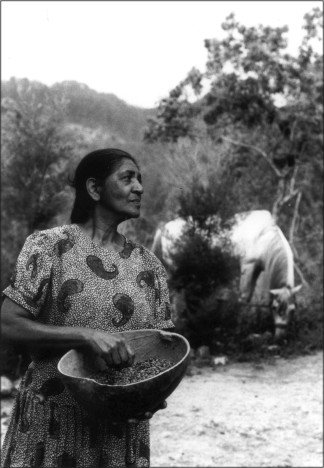 Hunger's
atomizing effect upon communal bodies is not unique to the Brazilian
Northeast. Jean Dreze and Amartya Sen note that when communities
hunger, "the ordinary rules of patronage, credit, charity,
reciprocity, and even family support tend to undergo severe strain and
can hardly be relied upon to ensure the survival of vulnerable
groups."
Hunger's
atomizing effect upon communal bodies is not unique to the Brazilian
Northeast. Jean Dreze and Amartya Sen note that when communities
hunger, "the ordinary rules of patronage, credit, charity,
reciprocity, and even family support tend to undergo severe strain and
can hardly be relied upon to ensure the survival of vulnerable
groups."