|
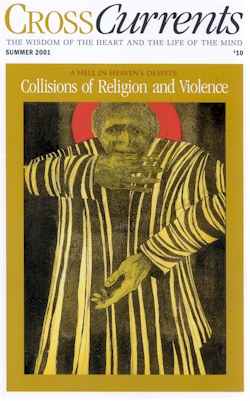
Collisions of Religion and Violence: ReduxThe terrorist attacks of September 11, 2001 have brought to the focal point of public consciousness a topic that was featured in the Summer issue of CrossCurrents: namely, the relationship between religion and violence. In that volume, several of our writers focused on the ways in which violence is dealt with within the Judeo/Christian tradition. Since the events of September, Islam has become a subject of renewed interest as well as much misunderstanding. The wanton destruction of life at the World Trade Center has reinforced the presumption of the part of many that Islam is a religion more likely to offer a justification of violence than other world religions. Meanwhile, Christians and Jews in the United States and elsewhere are wrestling with the question of how their faith might inform their view of a "war on terrorism." Does the Judeo/Christian tradition provide a basis for the use of violence even in a cause that is just? If so, what is the basis of that justification, and what limits might the tradition impose upon the use of force as an instrument of foreign policy? Are there significant differences between the fundamental teachings of Islam, Judaism and Christianity in this context? And above all, what are the prospects that these three world religions, which are part of the one Abrahamic tradition, might actually contribute to justice and peace in a world now poised on the brink of war? To help address such questions, we have assembled here, in addition the articles from the Summer issue, several articles that hopefully provide a basis for constructive conversation across lines of religious difference. Readers interested in exploring similarities and differences among Christianity, Judaism and Islam might want to begin with Johan Galtung's survey of major world religions: Religions, Hard and Soft For a clear and compelling statement of basic Muslim teaching, few have presented it better than Riffat Hassan, who teaches at the University of Louisville. What Does It Mean To
Be Muslim Today? The Politics of
Religious Correctness: Islam and the West From the Summer issue: Written and published prior to the September 11th terrorist attacks, the following articles from the summer issue clearly illustrate that the problem of violence is one that Christians and Jews have been wrestling with for centuries and not always with results that can be admired. Editorial: The Image on Impact
Notes on God's Violence
Blood & Stone: Violence in the Bible & the Eye of the Illustrator The Violence of God: Dialogic Fragments The final selection from this series is essential reading for Christians who have difficulty seeing the shadow side of their own tradition, or fail to understand how the Christian faith can be so deeply feared by so many.
Violence in Christian Theology Additional articles:
When I Boarded the Midwest
Express to Washington, D.C., on September 11
Theology and the Clash
of Civilizations
To Whom Shall We Give Access to Our Water Holes?
The Gospel of Peace and the Violence of God
On the Rhetoric of a "War on Terrorism"
Experiencing Violence, Shaping Identity,
Negotiating Life Having seen how religion can sometimes inadvertently contribute to a "culture of violence," Elise Boulding outlines what it might take to build a "culture of peace." Peace Culture: The Problem of Managing Human
Difference Whether or not religion plays a constructive part in the struggle for justice may well depend on how the relationship between faith and politics is mediated in various societies. Religion, Politics,
and the State: Cross-Cultural Observations Economic Sanctions, Just War Doctrine, and the "Fearful
Spectacle of the Civilian Dead Whether of the Christian or Muslim variety, fundamentalism is the scapegoat that secular societies as well as mainstream religious leaders love to despise. This may be a fatal mistake, argues Peter Huff, persuasively.
The Challenge of Fundamentalism for Interreligious Dialogue Whether one wrestles with the ethical implications of war making, biomedical ethics, or end-of-life decisions, being able to distinguish what falls properly under the providence of God from what lies within the scope of human responsibility is critical. Playing God: Divine Activity, Human Activity, and
Christian Ethics Islam and the Trialogue of Abrahamic Religions Vaclav Havel is regarded by many as having a clearer sense of how spirituality can be a mediating force in the confrontation between cultures of the East and West than any other. A Sense of the Transcendent
|