|
What Makes a Jewish Home Jewish?
by Vanessa L. Ochs
Stuff in a
Jewish home is more than just stuff: it's Jewish stuff.
VANESSA L. OCHS is in the Department of Religious
Studies of the University of Virginia and author of Words On Fire: One
Woman's Journey into the Sacred (Boulder, Colo.: Westview Press, 1999).
An earlier version of this article is also available on the web site Material
History of American Religion: http://www.materialreligion.org/journal/home.html.
An elderly Jewish informant in
Barbara Myerhoff's book, Number Our Days, tells a story which he
attributes to Martin Buber to prove to his community that a ceremony whose
authenticity some doubted was indeed the real thing. "It tells here about
two men who are worried about the holiness of the Sabbath. 'What is it that
makes something holy?' they ask. They decide to make a test to see what
happens when they have Sabbath on a weekday. So they make the Sabbath in the
middle of the week, everything they do right, and it feels the same way as on
Saturday. This is alarming, so they take the problem to the rabbi to explain.
Here is what the rabbi tells them: 'If you put on Sabbath clothes and Sabbath
caps it is quite right that you had a feeling of Sabbath holiness. Because
Sabbath clothes and Sabbath caps have the power of drawing the light of the
Sabbath holiness down to earth.' " (1978:105)
The Revelatory Nature of Things
More scholars of religion are now acknowledging what religious or spiritual
people worldwide have long known, from observation, lived experience and
intuition: that material objects -- things made by people -- are vessels that
create, express, embody, and reflect sacredness, or, to use the Jewish term
which describes abstract and concrete movement toward sacredness: kedushah.
Material objects are not just tangible stand-ins for the stuff of greater
weight and value that count more or mean more in the big academic and cosmic
schemes of things -- such as ideas and ideologies in texts, beliefs held by a
people or expressed in theologies, and dutifully recited articles of faith.
Like others whose research leads them to consider the illumination that is
possible when the connections between religion and material culture are made
(including John Cort, Colleen McDannell, Leigh Schmidt, Robert Orsi, and Jenna
Weissman Joselit), I am not suggesting that objects are more eloquent, more
instructive, or more essential than sacred texts and sacred beliefs in
constructing religiosity, establishing religious identity, or studying
religions. Following the lead of those scholars mentioned above, I am
suggesting that objects are neither less eloquent nor less pivotal either. As
John Cort has asked (JAAR 64, no. 3), what would happen if we
looked at text-heavy and less text-bound religions with "material culture
as our starting point"? (615) "If we look first at the objects and
base our attempts at understanding on them, will we emerge from our study with
a different view of the tradition?" (615)
People who live and construct religious, spiritual lives have known that
things are teachers and things are revelatory; they know it in their bodies,
as common sense, and express their knowledge in the verity of aphorisms:
"clothes make the man," "you are what you eat." With
chicken-or-the-egg circularity, we make things, things make us; things make
us, we make things. If this were not true about things in Judaism, the central
mitzvah (sacred obligation) of Passover would be reading about or
contemplating bondage in Egypt, but it is not. Were the real matzah
(the sacred obligation one bakes or buys, displays, eats, and hides) less
important than the abstract idea of matzah, Jews could read or think
matzah, and neither make, use or consume it. Rather, the experience of
bondage, the memory of bondage, and the possibility of new expressions of
bondage are made tangibly present in the matzah, the flat cracker that
proclaims in its shape, taste, crumbling fragility, and digestive
after-effect: "This is not-bread, this is the not-bread of
affliction." So the matzah matters, and, consequently, so does the box it
comes in -- the brand name, the country of provenance (especially if it's
Israel), the competing sale prices at Waldbaum's and the Food Emporium
published in full-page New York Times ads, the rabbi whose name
certifies, endorses, and seems to extend enduring blessing to the purchased
matzah. The plate the matzah rests on matters, and so does the cover placed on
it (crude, but beloved, for it was made by one's child back in nursery school,
or costly and beautiful, designed and embroidered by artisans and representing
one's good taste or economic fortune or the ritual of marking weddings with
the gifting of Judaica). And it matters where on the Passover table the matzah
is placed, and who sits nearest to it, and who is selected to uncover it,
point to it, bless it, divide it for others, and determine who gets it first
and who gets what size. It matters who piles the matzah high with horseradish
and haroset, and who is chosen to hide it, and who to find it, and who to
subsidize the reward for its discoverer. And what an important thing that is,
the retrieved hidden matzoh, for only its discovery permits and creates the
conclusion of the Passover seder.
In Judaism and, I imagine, most other faith traditions, the spiritual is
material. Without things, in all their thingness, there is no Passover, only
an idea of Passover; and a faint and fuzzy idea it would be, like honor,
loyalty, and remorse -- like, perhaps, God, and more surely, monotheism.
Things denote one's belonging, one's participation, possibly one's
convictions. Listen to Jews interrogate each other about the intensity of
their commitment and connection to certain fundamental indicators of
conscious, intentionally lived Jewish life. They do not typically ask,
deuteronomically: "Do you believe in God with all your heart and all your
soul and all your might?" They will not ask, decalogically: "Do you
remember that God rested on the Sabbath day by keeping it holy?" Rather,
they inquire about the materiality of lived-out beliefs and habits of
conviction: "On the Sabbath, do you drive your car? Carry keys? In your
house, do you separate your meat and milk dishes in different cabinets and
have two sinks? Do you cover your head, wear a wig, put on tefillin, hang a
mezuzah on your door, sleep in separate beds, eat cold food out, light
menorahs, spin dreidles. . ."
Material Culture in the Jewish Home
Where are most of these things that point toward and create Jewish life and
identity but in the home -- in Bachelard's words, "our corner of the
world. . . our first universe, a real cosmos in every sense of the
world"? (4). Within Jewish homes, things, people, and even times of day
and seasons of the year and of life interact in a fluid process, through which
things make the home Jewish, by which things are animated by Jewish life and
absorbed by it in specifically Jewish ways. This idea is well-expressed in
Sylvia Rothchild's autobiographical account of the holiday Shavuot, which she
refers to in the Yiddish, Shveeis: "On Shveeis, the
three small rooms our family of five called home became a magical place, a
stage, a bower redolent with the smell of fresh green leaves, roses and
peonies. My pleasure was not only in the transformation we brought about but,
even more, in the seasonal discovery that it was possible to alter what was
familiar and prosaic, that escape could come not only in daydreams but through
physically changing things" (Reading Ruth, 146).
Anthropologist Leedom Lefferts, who studies the spiritual lives of Thai
textiles, has suggested this provocative question (personal communication,
1997): If things have social lives just as persons do, could we consider that
they have religious/spiritual lives as well? To this I would add another
question: Could we consider the possibility that things in a Jewish home have
Jewish identities, as solid, erratic, or angst-filled as the Jewish identities
of people? For just as memory recovers lost, stolen, and rejected worlds and
ways of being left behind, do not objects -- those present, those retrieved,
and even those dimly recalled -- do the same?
In my anthropological research on Jewish-American material culture in
homes, I have been attending to how my human informants, the creators and
keepers of Jewish homes (more often women than men, but not always), reflect
upon how things make their homes Jewish, and how things found in the home
facilitate Jewish living and create, maintain, and transmit Jewish identities.
Three years into this project, I have been struck over and again: If
informants do not come from Orthodox homes, and if they are not rabbis, they
routinely express anxiety that I may have come to the wrong place and am
wasting my time. Despite an impressive inventory we have just taken together
in a home of over a thousand Jewish things, some are bound to claim that their
Jewish home is still not "Jewish enough" or "really
Jewish." They will acknowledge that while their home can be read as
"Jewish space," by outsiders -- Jewish or not -- it may not be
"sufficiently Jewish" to transmit Judaism successfully to the next
generation. (Visible transmission to the next generation is the fashionable
contemporary benchmark in many Jewish communities for one's success as a
Jewish parent: raising children who stay within the fold and marry within the
fold because they have come from what is called "a good Jewish
home.") One informant claimed that the presence of Jewish objects in her
home that do not always get used in the "right" ways and at the
proper times, or are used with too little confidence and too little
understanding, serve for her as concrete, continual, and condemning evidence
that her Judaism is marginal and inauthentic. Other informants suggested that
if I wanted to see a "real" good Jewish home, I should look
elsewhere. While I have not taken their advice and gone elsewhere, I have been
trying to grapple with the questions raised by their resistance to seeing the
Jewishness of their most Jewish homes. Why are my informants so anxious about
what does and does not count as authentic Judaism? Why are they overwhelmed by
the pervasive feeling that they cannot create an aura of Jewish authenticity
in their environments?
In my research, I have identified three sometimes-useful categories of
things as we look at what makes a Jewish home Jewish and how these things do
the making. In the remainder of this article, I intend to conduct a brief tour
of one home that "makes Jewishness" by its objects -- even when the
home-keeper claims that the home is insufficiently Jewish -- and then outline
those categories which have helped me organize objects to see better how
things make a home Jewish.
The Jewish Home Tour
My informant, Susan, is a past president of a Conservative synagogue in
suburban New Jersey, the mother of three daughters who have celebrated bat
mitzvahs. Professionally, she is a quilter; she is married to a doctor. She
received some formal Hebrew school education as a child and teenager, reads
Hebrew, and has studied Jewish history, beliefs, and practices for two
intensive years; she can chant Hebrew prayers as well as the ancient tunes for
the readings from Torah and Prophets. A leader in her community Jewish
federation, chairing education and outreach committees, she is also a member
of the Jewish women's organization Hadassah. She has participated in a women's
rosh hodesh (new month) group that studies books and issues in women
and Judaism and is a Lion of Judah, a woman honored for her substantial annual
financial contributions to the Jewish community.
Susan meets me at her front door, and as we stand underneath her mezuzah, a
cloisonné objet d'art she has brought back from one of many
"missions" to Israel, she explains that she is always taken aback
when friends or acquaintances tell her that she is the most Jewish person they
know. They turn to her for information: Can you serve rice on Passover? On
which side of the door do you hang a mezuzah; and what is Shavuot (beyond
blintzes), anyway? She laughs, saying: "I fear for Judaism if I am the
most Jewish person anyone knows. Though I am to the core Jewish, I am not an
authority on learning and observance."
She narrates her Jewishness this way: "We're not religious-religious,
but we always light Shabbos candles and have challah, even if we're going out
after. Daisy, our golden retriever, comes and sits like a perfect dog as soon
as she hears the challah coming out of its plastic bag. And after the
blessing, she gets some. We bless her just like we bless the girls. Daisy
knows when it's Friday night."
Despite Susan's protest that she is not sufficiently Jewish by her own
standards (although her dog may indeed be a Jew in good standing of the
Pavlovian denomination), she takes me on a detailed tour of the profoundly,
explicitly Jewish home that she has made and that makes her. Her discussion of
and reflection upon things in her Jewish home suggests that there must be
blind spots in her Jewish identity -- ways in which she can articulate, but
not altogether acknowledge the Jewishness of her home, ways that keep her from
claiming it.
Walking through the door, Susan says, "I notice the relationship
between who people are and how they arrange their homes. So when I go into
Jewish homes, I am acutely aware of the home atmosphere, what people choose to
put places. Parts of my own home really reflect who I am, and parts of it, I
just live with. To me, a Jewish home is books. They don't have to be Jewish
books. If I don't see books, I don't think it's a real Jewish home. I am
ordering more bookcases for my living room." If Susan measured the
Jewishness of her own house by books alone, she would score well. In her
library, she will soon show me prayer books for everyday, Sabbath, and
holidays, Hebrew dictionaries, books on Jewish literacy, Jewish histories,
coffee-table art and photograph books of Jews and of Israel, and a respectable
collection of texts that have emerged out of Jewish feminism and Jewish
renewal.
But without looking further, she shows me a ring she wears, what she calls
her "most significant piece of jewelry," emphasizing the
"Jew" in "jewelry." She explains that her father used to
sing in the synagogue chorus in the Mount Airy neighborhood of Philadelphia,
and for his service received a ring with the Hebrew letter shin on
it; either the shin stood for the word sh'ma (listen) or it
was just his initial. He wore it always on his third finger. Hospitalized
before his death, he called Susan to his bed, asking her to go to his jewelry
box and get his ring. Susan got it and gave it to him. After her father died,
the ring was given to her, and, she explains, assuming I will know what it
means, she wears it always.

Inside the house, there is what Susan calls "Jewish stuff"
everywhere. "I love tzedaka (charity) boxes. And I try to have
at least three of everything so I can give them to my three kids so they will
know they came from me and my home. If you have spare coins, you can put them
in any box, because many boxes are lying around." (Indeed, there are
standard JNF -- Jewish National Fund Charity -- boxes, but also boxes shaped
like her synagogue, like her house, and like a chicken). "When a box is
full, I confer with the family, and we decide where to give the money; it
could be to something Jewish, or something like juvenile diabetes. And photos
are very Jewish things: it's important to have photos of family around the
house because family is Jewish and that's us, that's who we are, and family's
important to me." ("I say to 'me,' " she adds, "because it
means so much to me to arrange parts of the house.")
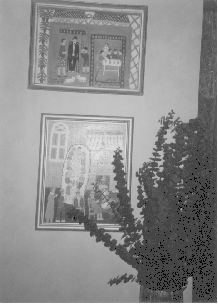
In her house, mixed among valuable objets d'art and fanciful folk
paintings, sculptures, and ceramics made by the Jews of Israel, Russia,
Ethiopia, and America, are sentimental drawings and paintings from Prague and
Israel. The imagery is familiar: Russian grandmothers in kerchiefs, milkmen
like Tevya in villages like Anatevka, lions of Judah, doves of peace, stars of
David. The others traveling on Susan's mission to Israel, she says,
"couldn't scoop the paintings up fast enough." Other artwork comes
from a gallery near Jerusalem's King David Hotel. "They look like
Jerusalem and I love images of houses and neighborhoods, and I hung it next to
my pictures of Cape Cod, which I also love." Fine Jewish folk art
paintings also come from the gallery. Susan explains, "I know it can seem
extravagant, but I like leaving money there (in Israel, that is.)" She
pauses to assess what my inventory may have already revealed: "Does this
make a Jewish home? Not in itself, as anyone could hang up this stuff. But
would they? It's the gestalt. As my daughter Molly says, my Jewish things
reflect Jewish actions."

When we reach the dining room, Susan narrates the story of her father's
seders in his dining room. As Bachelard writes, ". . . the
house is not experienced from day to day only, on the thread of a narrative,
or in the telling of our own story." Through dreams, through memories,
"the various dwelling places in our lives co-penetrate and retain the
treasures of former days" (5). "After my father died," Susan
says, "we had the seder at my brother's house. We couldn't have done it
there in my father's lifetime; my brother was not observant enough. But damn
it, we said, we were going to have a meaningful seder, even without our
father." Susan questions the legitimacy of the Seders after her father's
death. "It's not really authentic. It's what we as a family can do. We
got our own copying machine. This year, for two days before Passover, I copied
from other hagaddahs I have collected, and cut and pasted. I was nuts. I took
out the tear-jerker passages that were in the hagaddah. I put together the
seder the year right after my father died, because I decided, this year, I
wanted to move forward. My father's sister and cousins came. We had more than
thirty people. Everyone came. I got a lady to help. The hagaddah I made isn't
ritually right, but it's OK for us. I pass out my big collection of hagaddahs
for people to look at and put out my three seder plates and everyone has their
own kiddush cup."
Susan shows me an eleven-page, stapled, xeroxed document called "The
Rosenblum-Adler Family Hagaddah." On the cover border is a clip-art
multigenerational family in a circle dance; at the center is a jolly family
toasting with cups of Passover wine. Captions extending from their mouths
read: "L'Chaim! Yummy! Welcome! Passover Rocks" (referring, I
presume, to the matzah balls.) As Susan explained, it is a stitched-together
document, but the introduction appears to be hers. It reads: "Just as we
sometimes deviate from the exact route on a printed map when we travel, we can
make adjustments and deviations in this seder (order) too. But the basic
signposts are here for us." In the "Rosenblum-Adler Family Hagaddah,"
the entire second half of the seder, that which follows the festive meal, is
omitted, just as it is omitted in practice in many American-Jewish homes.
Indeed, this hagaddah, which Susan calls "very liquid, with a slight
feminist bent" does deviate. It ends with the eating of matzah,
horseradish, and haroset, and a toast to freedom with a second cup of wine.
The rest of the seder which follows the festive meal is omitted. Evaluating
her creation, defending and critiquing it in one breath, Susan says,
"There's too much cognitive dissonance between what a rabbi and the
hagaddah say you should do on Passover and what my family will actually do.
You have to make traditions that can stick. At the same time, you have to be
true about things."
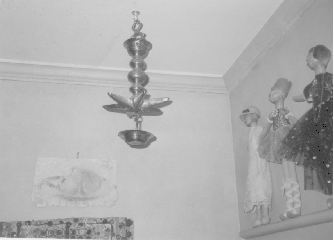
In a corner of the dining room hangs a brass Sabbath light, an exceedingly
curious piece of Judaica in an American home. "People see it and say,
'How come you have an eternal light in your dining room?' But that's not what
it is. It's a shabbos light from Kenny's family. His family was not observant
for the last generations, but they were very Jewish, from Baden-Baden, and
this was their family heirloom. The family said to me, 'You might appreciate
this,' and I was thrilled to have it."
Inadvertently, Susan demonstrates the transformational capacity of things
in a Jewish home as they become Jewish, or are designated to be so, by
performing a Jewish function, for a first time, and then forever after.
"I have this thing," says Susan. "I turn things into Jewish
ritual objects if I want to. In Prague," (a place which she identifies as
having deep Jewish meanings for her) "they have beautiful glasswork, so I
wanted to bring something home, so I turned this chalice into a kiddush
cup." Chalices found in Paris, Prague, Boston, and Cape Cod also met
similar fates. Brought home, they were dedicated -- or they dedicated
themselves -- to sacred Jewish service, and now live together on a tray, a
monastery of now-kiddush cups. Dreidls are, like kiddush cups, in abundance.
"I keep my dreidl collection out all year. They range from the sublime --
silver, ceramic, and cloisonné -- to the ridiculous -- plastic. I get them as
gifts. I also turn things into dreidls. A top, a Christmas ornament: I make
them dreidls. I like that." In Susan's hands, and in her home, homeless
Jewish objects become ba 'alei tshuvah, masters of return, rescued
like Russian or Ethiopian Jews, and then subjected to being domesticated as
American Jews. Non-Jewish objects submit to conversion.
I inventory the kitchen: piles of Sh'ma magazine, Moment,
Tikkun, Hadassah, and Bon Appetit (dog-eared on pages for latkes
and flourless Passover tortes). More prints of an old synagogue in Prague,
images of Jewish people floating, a cross between Kabbalah and Chagall. No
great art here: Susan says none cost more than $25, but all speak to her.
"The image is Jewish, having them reminds me where I was, gives me a good
luck charm. I like the mystical piece of it." On a kitchen shelf, I
inventory Jewish sounds: piles of CD's of singer Paul Zim, classic cantorial
pieces beloved by Susan's father, Barbara Streisand, and Klezmer bands. On one
wall is a framed needle point of the word SHALOM made twenty-five years ago,
framed photographs of Susan as chair of the UJA Women's division, bubbe and
zayde dolls, over a dozen Jewish cookbooks, a refrigerator magneted with bar
and bat mitzvah invitations and photographs of a nephew's recent bar mitzvah,
a synagogue calendar and directory, and more tzedaka boxes. On a
shelf are Jewish videos ("Shalom Sesame," an animated hagaddah, the
Rugrats celebrating Passover), three challah trays, a tray of six sets of
Shabbos candles, and a tray of silver kiddush cups that stays out always. Some
were gifts, some inheritances from parents' collection, others the booty of
clandestine rescue missions. "I buy kiddush cups at antique shops. I take
them away. I rescue them. I don't want anyone who doesn't know what they are
to have them."
Having scanned the surfaces of the kitchen, I request that we look behind
closed doors: the refrigerator door, the cabinet doors, the food pantry. Susan
grows tense for the first and only time and wants to assure me that here, in
the "Really Jewish" Olympics, in the kitchen event, she is about to
lose not only her standing but her very position as a contestant. "I do
not keep kosher," she admits apologetically, as if I might be
disappointed, offended, or bound to judge her poorly. Then, she adds, as if
she might qualify under shifted rules for a "Special Jewish"
Olympics, "But we do have A LOT of food." Still, in the
refrigerator, I find a half-used Kosher-for-Passover bottle of horseradish, a
jar of Manishevitz borscht, a bottle of Kedem Kosher Concord grape wine.
Susan explains that she gets very traditional around holiday times. "I
am at my best on Jewish holidays. I make better chicken soup than my mother. I
love shopping for the holidays. I love telling the vegetable man that I'll
need horseradish or soup greens." She boasts that she makes special trips
to the fancier bakery to buy Sabbath challahs, and jumps at the chance to find
challahs that are "more tasty, more authentic." This exuberance and
ambition translates to making New Year honey cakes, Purim hamentaschen, all
the Passover ceremonial foods, and nut and sponge cakes.
Explaining her house-rules for partial kashrut, she says, "We don't
have pork products, but we do have shellfish" -- expressing, as I hear
it, a not-so-idiosyncratic distinction between signs that are more and less
potent indicators of boundaries in Jewish life. When we get to the freezer,
there are packets of meats from the kosher butcher. I am surprised by the
presence of kosher meat in a non-kosher home. Because I cannot understand why
she goes to the added trouble of securing and paying more for kosher meat, I
ask if she finds kosher meat fresher or tastier. It actually has nothing to do
with the meat, she explains. She has kosher meat delivered by a kosher butcher
once a month because she likes the idea of the kosher butcher delivery man
coming to her home, as it reminds her of such deliveries growing up in her
childhood home. The deliveryman brings more than a box of meat. Says Susan,
"When the kosher meat delivery man comes, I feel a sense of Jewish
community." Arriving, he'll tell her that he's late because he just came
from the Mandelbaums, and they ordered double, because the children and
grandchildren were coming in from Israel for all of Passover. Departing, he'll
tell her that he is not going to the Shapiros because Mrs. Shapiro is in
a nursing home, and Mr. Shapiro is staying with his daughter in
Montclair. Leaving for the next home, the deliveryman, Susan knows, will take
with him the salient news of her household and deliver it, along with his
goods, to the next house.
Idiosyncratic kashrut extends to Passover. In Susan's basement, stored next
to a basket of hagaddahs, Israeli ceramic candlesticks, and a seltzer bottle
from her youth, is a box marked "Passover dishes." Why would she
keep separate dishes for Passover when she does not keep separate milk and
meat dishes for the whole year? Susan explains how she makes sense of this
seeming curiosity. "I know this isn't quite right, but it works for us.
Growing up, I remember unpacking the Passover dishes from a box as we got
ready for the holiday. So I keep the tradition. I couldn't use paper plates
either, because it's very important to set a beautiful Passover table."
Then there are clothes. As we go up to her bedroom, Susan points to the
colorful vest and nice jeans she is wearing. Jokingly, she says she is dressed
to the nines to perform a weekly mitzvah, taking a woman out for lunch to
divert her from an arduous course of chemotherapy. Other clothes and objects
are also mitzvah-connected. Hanging in Susan's bedroom closet is her
Lion of Judah pin, a premium given to women who make outstanding annual
financial donations to UJA. Susan explains that when she wears her Lion of
Judah pin on a certain suit for a UJA event or luncheon, it gets to stay on
that suit, offering it attention and dignity, until the next event and the
next suit are selected. Susan says she is somewhat uncomfortable with the
message a woman wearing her Lion of Judah pin can broadcast: "Oh look who
she thinks she is that she has so much money." It has a good side, she
admits, as it shows the extent of one's commitment. In her jewelry box, she
counts sixteen different Jewish stars (some from childhood), one pincushion of
Torah Fund pins representing donations to the JTS (Jewish Theological
Seminary), and another pin cushion of Hadassah pins.

Susan's bedroom is a landscape of shrines containing photographs of
relatives who are ill. Says Susan; "I have this thing about talismans. My
Aunt is sick, so I have photos of her." Framed birth announcements for
her three children and her own wedding announcement are all very important
Jewish objects, she says. In her dresser is a random assortment of kippot
(head coverings) from bar and bat mitzvahs, along with the Bukharian
embroidered pillbox kippah she wears when it is her turn to do "bima-duty"
on the altar next to the Rabbi as a representative of the Board of Directors.
On her bathroom mirror is a sticker the rabbi gave out to the congregation on
Rosh Hashanah some years back. It says, "I am created in the Image
of God."
How to Make Sense of Material Culture
As I said earlier, three categories of objects help me to understand and
experience what I am seeing. I trust such categories can be useful as methods
of making meaningful groupings for other students of religion who start from
home and material culture.
Articulate Objects
First, certain standard markers serve as unambiguous "signs" or
"indications" that a Jewish home has been intentionally constructed,
and is being continually constructed -- by the objects themselves and by a
range of interactions people have with these objects. Call this first category
of objects: articulate, revelatory, self-evident, and unambiguous. One could
call objects in this category: signs which say "a Jew lives here";
props which say, "I am needed in Jewish life"; or catalysts which
say, "my very presence creates Jewish ways of being and doing."
Often they are all three: signs, props, and catalysts.
Such things in this category facilitate, instigate, or suggest Jewish ways
of being, create and enforce Jewish identities, and serve as reminders that
the home one is in is Jewish. One informant has described such objects as the
boundary-keepers she sets up in order to distinguish and protect the Jewish
identity of her home from the largely non-Jewish world in which her family
lives. One could just as easily say that it is not this informant who is
setting up the objects to create boundaries, but the objects themselves that
create a boundaried world in which my informant lives. In Jewish-American
homes, the most familiar and visible objects in this category might include a
mezuzah, Chanukah decorations, Sabbath candle sticks that are displayed and
used, a kiddush wine cup (often silver), a prayer book, a Bible and other
ancient sacred Jewish texts, a Jewish calendar (distributed by a synagogue,
kosher butcher, or Jewish funeral parlor), a drawer of yarmulkes harvested
from various celebrations, a Chanukah menorah, artwork depicting Jerusalem,
displays of New Years, Chanukah and Passover greeting cards that change with
the season, sentimental or nostalgic artistic images of serene shtetl
mothers in scarves lighting Sabbath candles or bearded old rabbis worshipping
and studying in destroyed European villages, tzedaka coin boxes
designated for some Jewish cause or charity, kosher wines, loaves of challah,
the boxes of matzah. And just about anything with Hebrew letters written on
it: from an illuminated ketubah (wedding contract) and Hebrew letters
in primary colors magneted onto a refrigerator to a red-and-white can of
Israeli Coca-Cola, brought back as a souvenir from an El Al flight to Israel.
Things that are signs, props, and catalysts enter one's home in a variety
of ways: as purchases, souvenirs, gifts (from relatives, friends, and the
Jewish community), inheritances, hand-me-downs. Sometimes they are quietly
"borrowed" from synagogues, in a kind of surreptitious lifetime
loan. Sometimes they are acquired once in a lifetime -- like a pair of silver
candle sticks; sometimes they are reacquired annually and consumed or used up
-- like Chanukah candles or a Jewish calendar; and sometimes they are acquired
annually, and after they have surpassed their initial intended use, they are
saved and transformed. I am thinking of etrogs (cítrons used on Sukkot)
turned into pomanders (to be smelled at the end of the Sabbath in the
Havdallah ceremony) and pieces of afikoman (the matzoh that is hidden and then
found at the Passover seder) hung over doors as amulets to increase one's
blessing. Frequently, things in this category have important stories that are
attached to them or that are readily and even customarily evoked by seeing
them or using them. When the story is so central, sometimes the object is not
used as it is intended to be and, instead, remains on constant or periodic
display, as an aide-memoire to recapture the story. One kind of story, the
story of acquisition, is frequently elicited by these objects. In the telling,
one learns who gave the object, why they gave it, when they gave it
(particularly if it was a special occasion, like a birth, bar or bat mitzvah,
or wedding), what the giving meant initially and what it means now as a
connection between giver and recipient. Barbara Myerhoff would include what
she calls symbolic jewelry. She describes the elderly Jewish women wearing
"expensive gifts from their children -- golden medallions bearing
grandchildren's names; 'Tree of Life' necklaces studded with real pearls;
Stars of David; and the golden letter 'chai,' Hebrew for life and luck. All
were announcements of connections, remembrance, and esteem" (Number
our Days, 206-7).
As Kopytoff has demonstrated (64-91), objects as well as people have a life
span, stories that can be narrated about their lives and network of
relationships. Just as stories of human birth matter (the story of when you
were born), the birth story of an object, or its entrance into one's home,
matters. Another story that Jewish objects evoke is the miracle story of
rescue or survival against great odds. The object that first comes to mind is
a broken silver Sabbath breadknife that one family hid under floorboards
during the Holocaust and later retrieved, the sole tangible surviving sign of
their Jewish material life. Some objects in this first category are considered
to have higher level of holiness, kedushah, than others because of
some aspect intrinsic to its structure or composition. The mezuzah, for
example, contains parchment with verses of scripture written on it; the
holiness is raised to an even higher power because these verses contain the
written name of God. The holiness quotient of the mezuzah would be reduced if
there were a mistake or defect in the writing or a tear in the parchment.
Holiness would also be reduced if it were installed on the wrong side of the
doorway or if it were placed too high or too low.
While the base-level holiness quotient of a mezuzah could remain the same
from home to home, non-intrinsic and personal or sentimental aspects of an
object also increase its holiness (one could also substitute the word
"preciousness.") For instance, one woman takes out her deceased
father's yarmulke and prayer book each Friday night and places them next to
the Sabbath candlesticks she lights. As it happens, she neither wears the
yarmulke nor reads from that fraying prayer book, but because they evoke and
represent her father's presence, and remind her of how the Sabbath entered his
home, they are objects of higher sanctity, more potent or powerful than other
yarmulkes and prayer books she owns, even if they are not used in conventional
ways. Thus, while objects within this category often have codified rules and
customary or traditional expectations connected to them, idiosyncratic usage
-- or personalization -- can honorably prevail and even add value. For
comparison, I note the Pentecostal prayer handkerchiefs, which were thought to
procure healing, studied by R. Marie Griffith (1997). The handkerchief
was considered to be a "sacramental object of divine prayer" which
one sweated and prayed over; ". . . these objects themselves
were thought to be saturated with a kind of power through these signs of
intensive prayer." When speaking of objects in this category, my
informants acknowledge there is often a distinction between what these objects
"really mean" (the theological meaning a rabbi would know) and what
these objects actually did mean to them once, do mean to them now, and will
potentially mean when and if they are inherited. Colleen McDannell enforces
these distinctions in Material Christianity (17), where she observes
that meanings "articulated by a controlling institutional body with a
long history of custom and tradition" may not help us "understand
the personal meanings that people find in their daily use of religious
objects," which may mirror neither the "intentions of the clerical
elite not express the idiosyncratic whims of the masses." In this
respect, a mezuzah purchased in Jerusalem on one's twenty-fifth anniversary
will have a different valence than a mezuzah found in a synagogue gift-shop.
The anniversary mezuzah might be seen has having greater protective power and
potency precisely because it contains and activates both "powerful
personal memories" and "collective memory," a distinction
McDannell makes.
Placement of objects in this first category matters. Sometimes Jewish law
dictates the placement. The mezuzah goes on the right side of the door post;
the menorah goes near a window; the Sabbath challah goes on the table. Other
times, family custom dictates the placement: holiday cards go on the
refrigerator in one house, on the mantle piece in another, or the piano in yet
another. A public-private distinction may govern placement. A
"shalom" plaque on one's front door is meant for general consumption
and illumination, whereas a father's tefillin bag or bat mitzvah jewelry may
be kept in a drawer as a private keepsake. There is also a distinction between
objects that are used and objects that are displayed consciously to create a
shrine-like presence communicating commitment and belief.
This first category embraces a subset of objects whose very absence or
prohibition from use at specific times points loudly, articulately, and
evidently to the Jewishness of the space. Absent (or typically absent) are
specifically "other" objects such as Christmas trees, wreaths,
colored lights, and wicker baskets of painted eggs and chocolate bunnies, or
bacon and its smell. Prohibited, and hence placed out of sight or otherwise
rendered out-of-commission in particular times and places, are in some Jewish
homes: cars, money, and fire on Sabbath; bread and flour on Passover; mirrors
and leather shoes in the mourner's house.
Jewish-Signifying Objects
In a second category are objects that are not in and of themselves
considered explicitly or uniquely Jewish-signifying objects that create the
Jewishness of a home and point to it (for oneself and for others who enter the
space). Nonetheless, they also function, in many Jewish homes, to embody,
create, and express kedushah by their actual presence, by a hidden
presence of which one is consciously or subliminally aware, and also by the
whole range of interactions to which such objects are subject or suggest and
provoke. They participate in the fulfillment of mitzvot, the commandments, or
as Max Kaddushin would say, "Jewish value concepts." While the
definition of this category might seem curious, the objects that constitute it
are not. Consider books, some of which might be by Jews or about Judaism --
but also all books in abundance, filling shelves, piled on floors, spilling
off of tables, scattered in children's rooms. Consider foods, some which are
readily recognized as traditional Jewish foods for every day or holidays:
bagels, chicken soup, the Chanukah latkes, the Purim hamentaschen, gefilte
fish, and horseradish. But also included is all food in abundance, a pantry
and refrigerator sufficiently overstocked to serve one who "cooks for an
army" or one who urges those who dine to consume more: "Eat, eat.
You eat like a bird." Consider shrine-like displays of photographs, of
children, of parents, of ancestors, of extended families assembled at what
Jews call "affairs." L'dor va'dor, these things point from
one generation to another: family matters, love matters, keeping connections
matter, increasing and multiplying matter.
Ordinary Objects Transformed
In a third category, I place a whole range of material objects that could
be found in any home, but whose meanings and functions shift within the
context of a Jewish home. A dish is a dish, but in a Jewish home where kashrut
(the dietary laws) is observed, the dishes of a certain color or pattern
placed in a particular and separate cabinet become and remain milchig (milk)
dishes, and the dishes in another cabinet become and remain fleishig (meat).
The telephone is a telephone, but when it's being used by a Jew who is
checking on a sick friend who lives far away, it is a klei kodesh, a
holy vessel used in the practice of bikkur cholim, the commandment to connect
to the sick. All of the equipment one uses in house cleaning -- cleansing
powder, mop, Windex, Pinesol, vacuum cleaner -- is just cleaning equipment.
But in the Jewish home where Sabbath is observed by cleaning one's home
beforehand, we have again klei kodesh, holy vessels that create and
point to the Sabbath, tangibly, experientially, and sensuously.
In each case, we have objects that are endowed with meaning, memory, and
sacred purposes -- they are not changed, but they have the potential to become
charged, so to speak. Quoting Robert Armstrong, McDannell writes that "in
all cultures certain things exist which, though they may appear to be ordinary
objects, yet are treated in ways quite different from the ways in which
objects are usually treated" (18). She suggests that people
"activate or enliven" such objects, but we might consider that it is
also possible that the objects "activate or enliven" persons.
Bibliography
·
Bachelard, Gaston. The Poetics of Space. Translated from the
French by Maria Jolas. New York: Orion Press, 1964.
·
Cort, John. "Art, Religion and Material Culture: Some Reflections
on Method," Journal of the American Academy of Religion 64,
no. 3 (1996).
·
Griffith, R. Marie. "Prayer Handkerchiefs." In The
Material History of American Religion Project News, Spring 1997.
·
Kopytoff, Igor. "The Cultural Biography of Things: Commodification
as Process." In The Social Life of Things, ed. Arjun Appadurai,
pp. 64-91. New York: Cambridge University Press, 1986.
·
McDannell, Colleen. Material Christianity. New Haven: Yale
University Press, 1995.
·
Meyerhoff, Barbara G. Number Our Days. New York:
Dutton, 1978.
·
Rothchild, Sylvia. "Growing Up and Older with Ruth." In Reading
Ruth: Contemporary Jewish Women Reclaim a Sacred Story, ed.
Judith A. Kates and Gail T. Reimer. New York: Ballantine
Books, 1994.
Copyright of Cross Currents
is the property of Association for Religion & Intellectual Life and
its content may not be copied without the copyright holder's express
written permission except for the print or download capabilities of the
retrieval software used for access. This content is intended solely for
the use of the individual user. Source:
Cross Currents, Winter 1999/2000, Vol. 49 Issue 4.
|
